
Safe & Stress-Free Pet Travel from the UK
At Dundas Veterinary Group, our experienced Official Veterinarians (OVs) provide expert guidance on Animal Health Certificates (AHCs), Export Health Certificates (EHCs), and pet travel regulations, helping ensure your journey is smooth and compliant.
Pet Travel
Travelling with your pet can be an exciting and enriching experience, but it is important to give yourself plenty of time to prepare, as requirements vary depending upon the country you wish to travel to.
A UK-issued Pet Passport is no longer valid for travel into the European Union (E.U). Instead, an Animal Health Certificate (AHC) is required for each journey from the UK to the E.U. An E.U issued pet passport, with a valid rabies vaccination entry, can only be used if you can prove that your main residence is within the European Union.
Travelling outside of the E.U often requires more preparation, as an Export Health Certificate (EHC) is usually needed, and each country will have its own export requirements.
At Dundas Veterinary Group, we have a number of experienced Official Veterinarians (O.Vs) who can help you with the certification required.
EU Pet Travel Requirements (AHC)
To apply for an Animal Health Certificate (AHC), the following criteria for dogs, cats, and ferrets must be met:
-
Your pet must be microchipped.
-
Your pet must be vaccinated against rabies and be at least 12 weeks old.
-
Wait 21 days after vaccination (the day of vaccination is day 0). An AHC cannot be issued before this period.
-
For travel to the Republic of Ireland, Norway, Finland, or Malta, dogs must receive tapeworm treatment from an OV. This must be administered no less than 24 hours and no more than 5 days before entry into the EU.
-
The AHC must be issued within 10 days of entry into the EU.
-
The AHC must be issued for your first EU entry point but allows onward travel within the EU for up to 6 months.
-
Dogs must receive tapeworm treatment before returning to the UK (1–5 days before entry), recorded in the AHC or EU passport. Exceptions apply for direct travel from Norway, Finland, Ireland, and Malta.
We strongly advise contacting the practice in advance to ensure all requirements are completed on time.
For the latest guidance, visit:
https://www.gov.uk/guidance/pet-travel-to-europe-from-1-january-2021

Travelling from Great Britain to Northern Ireland
From 4th June 2025, the Northern Ireland Pet Travel Scheme allows non-commercial travel of dogs, cats, and ferrets from Great Britain to Northern Ireland, provided there is no onward travel to the EU.
Owners can apply for a Pet Travel Document (PTD) online:
https://www.gov.uk/apply-for-northern-ireland-pet-travel-document
-
Pets must be microchipped (checked on entry)
-
Rabies vaccination, tapeworm treatment, and AHC are not required under this scheme
-
The PTD is free and valid for the lifetime of pet ownership
-
Each pet requires its own PTD
-
A maximum of 5 pets can travel unless attending an event (with evidence)
If travelling onwards to the Republic of Ireland or EU, an AHC is still required.
More information:
https://www.gov.uk/taking-your-pet-abroad/travelling-to-northern-ireland
Travelling Outside the EU (Export Health Certificates)
Travelling outside the EU typically requires an Export Health Certificate (EHC), with specific requirements depending on the destination country.
Some countries require additional testing within strict timeframes before travel. These must be carefully followed.
We recommend preparing well in advance and checking requirements here:
https://www.gov.uk/guidance/apply-for-an-export-health-certificate
You should also contact the destination country’s embassy to confirm import requirements, as these may differ from UK export rules.
Tick Control for Travel in Europe
Although not required for an AHC, parasite protection is strongly recommended.
Ticks in mainland Europe can transmit diseases such as Ehrlichiosis and Babesiosis, which can be serious and difficult to diagnose.
Preventative treatments such as Bravecto (spot-on or oral) can provide up to 3 months of protection.
Sandfly & Mosquito Protection
Sandflies and mosquitoes can transmit serious diseases:
-
Leishmania (via sandflies) – can cause long-term illness
-
Heartworm (via mosquitoes) – affects dogs and sometimes cats
To reduce risk:
-
Avoid walking at dusk and dawn
-
Avoid marshy or stagnant areas
-
Use preventative collars (e.g. Seresto or Scalibor)
-
Consider vaccination for Leishmania in high-risk areas
Pet Health While Travelling
Travel can be stressful for pets, so it’s important to plan ahead.
Journey Planning
-
Schedule regular breaks for exercise and toileting
-
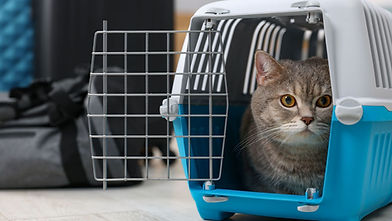
Ensure carriers are spacious enough (especially for cats and ferrets)
Temperature Control
-
Provide water, shade, cooling mats, or warm bedding depending on climate
-
Avoid excessive exercise in hot weather
-
Use appropriate insulation in cold conditions
Reducing Stress
Some pets may require additional support during travel:
-
Natural calming products
-
Prescription medication (if required)
Please speak to our vets for tailored advice. Note that airlines may have specific rules regarding sedation.