
Indoor & Outdoor Cat Care & Lifestyle Advice
At Dundas Veterinary Group, we understand that both indoor and outdoor cats can live happy, healthy, and fulfilling lives when their environment and lifestyle are carefully managed. While indoor living can be safer in busy urban areas, outdoor access allows cats to express natural behaviours like exploring and hunting.
Whichever lifestyle you choose, it’s important to support your cat’s physical and mental wellbeing. From providing enrichment, appropriate diet, and safe social interaction, to managing risks such as weight gain or outdoor hazards, small adjustments can make a big difference.
This guide offers practical advice to help you create a safe, enriching, and stress-free environment for your cat. Whether your cat lives indoors, outdoors, or a mix of both, our veterinary team is here to support their long-term health and wellbeing.

Keeping Your Cat Happy, Healthy & Stress-Free at Home
Deciding the lifestyle for your cat is dependent upon many factors such as accessibility to safe outdoor space, which can be especially difficult with city centre living.
Many cats can be suited to being indoor cats, but it is important to consider their welfare needs and ability to express their natural behaviours in a stress-free environment.
This factsheet considers practical aspects of keeping your cat happy in an indoor environment:
Bedding & Hidey Holes for Indoor Cats
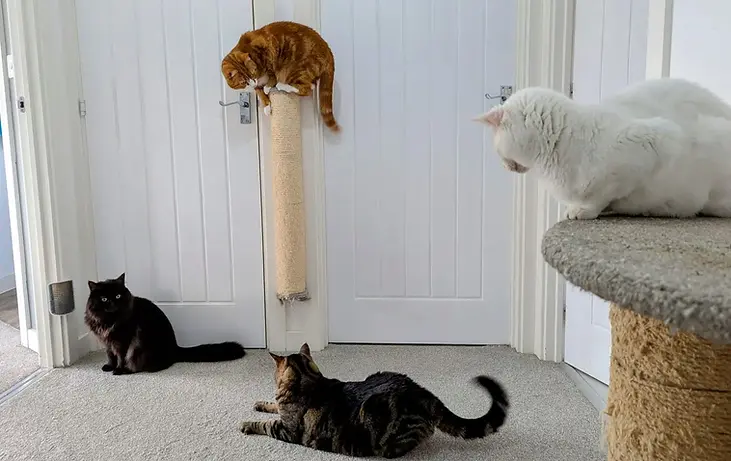
Cats love to climb and whether indoor or out it is great to be able to offer this. Many modern cat houses and climbing frames have raised boxes and hides.
This is especially important in multi-cat households.
Safe Toys & Play Time
Cats are natural hunters and encouraging playtime and interaction with them allows them to display this natural behaviour and reduces stress.
There are many cat toys (treat balls, fishing rods, laser pointers) which can help with this, allowing them to display behaviours such as stalking, chasing, pouncing and biting.
It also strengthens the bond formed with you as an owner.
Social Contact & Multi-Cat Households
It is important to take the time for social interaction with your cat, especially if indoors only.
If your cat is looking for attention, take the time to give the cuddles needed. It helps develop your bond and reduces stress for both pet and owner.
Many cats can enjoy living in social groups, but it is important to ensure there is adequate space and separate resources (i.e. litter trays, food bowls, beds etc) for each cat to reduce any competition.
Feline experts advise the number of resources + 1 for the number of cats in a household, i.e. if you have 2 cats ideally 3 litter trays, etc.
Litter Trays & Litter Type
Position litter trays in a ‘low traffic’, quiet area of the house away from windows.
Indoor cats can be more prone to urinary disorders known as ‘Feline Lower Urinary Tract Disease (FLUTD)’.
By appropriate number, positioning, regular cleaning of trays and suitable litter type we can help reduce the risk of these disorders.
Diet & Water for Indoor Cats
Outdoor cats often make use of water in the environment as they explore. Indoor cats should always have access to clean, fresh water, but consider the sources of the water.
Cats often prefer flowing water so a dripping tap or water fountains can be useful (remember to regularly clean the filters to avoid any mould exposure which can be harmful).
Make sure there are multiple water bowls with easy access throughout the house. It has been proven that cats prefer glass or ceramic bowls over plastic or metal.
The bowl should be wide and shallow to allow for your cat’s whiskers and ideally not a double bowl with food, as cats naturally eat away from their water source.
For multi-cat households ideally have their feeding bowls away from each other as cats are solitary hunters and prefer to eat alone.
Most cats have a mixed diet of complete dried food and some wet food, although some cats have a strong preference for one or the other.
Making the diet more wet food based for indoor cats can help to ensure urinary tract health.
Weight Control for Indoor Cats
Managing an indoor cat’s weight is often trickier than a cat with outdoor access as they tend to become more sedentary in their lifestyle, enjoying lots of comfy nap time.
As above, if you can encourage playtime and social interaction, this can help to keep your cat active.
Puzzle feeders can help to stimulate your cat mentally as well as encourage further activity.
Our vets will check your cat’s body condition at their annual routine vaccination check to give further advice.
Further Advice on Your Cat Care
Some great further advice from feline medical experts can be found on The International Cat Care website (formerly FAB):
https://icatcare.org