

Understanding Dental Disease in Pets
Dental disease is a major problem that affects around 70% of our pets and is often something many animals silently cope with. It is commonly identified during routine vaccination health check appointments.
Signs of dental disease can vary in severity but may include bad breath (halitosis), altered eating habits (such as eating on one side), preferring softer foods, reduced dry food intake or appetite, swelling above a tooth if an abscess has developed, salivation (sometimes with blood), and discolouration of affected teeth.
Early detection and treatment are essential to prevent progression, reduce pain, and protect your pet’s overall health and wellbeing.
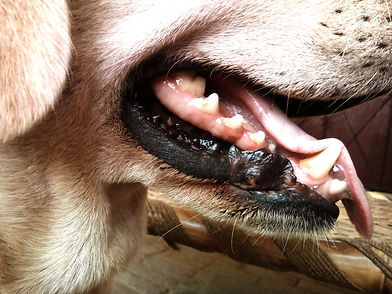
Causes of Dental Disease
Plaque is a mixture of bacteria and food debris which can accumulate and harden to form tartar/calculus. This creates a pocket for bacteria to penetrate under the gum line, leading to gingivitis (gum inflammation).
As this progresses, the tissue surrounding the teeth (periodontal tissue) can become inflamed, which weakens the support of the tooth, eventually leading to tooth loss (periodontal disease).
Cats have a specific form of dental disease known as a neck lesion/resorptive lesion (Feline Odontoclastic Resorptive Lesion), which can be very painful. With cats, it can be more difficult to detect painful cues, as they hide it more than dogs, but it can lead to altered eating, salivation and reduced appetite.
Treatment
Once identified, depending upon the severity of dental disease present, our vets will advise on the appropriate treatment plan.
Often this will involve a general anaesthetic so we can fully assess all the teeth. As cat and dog teeth have large roots below the gum line, dental X-rays are often required alongside special gingival probes to fully assess tooth and gum health.
Where the tooth is no longer viable due to infection or instability, surgical extraction is performed. Our vets often carry this out using additional local anaesthesia to maximise pain relief and minimise the anaesthetic gas requirement for your pet.
We place dissolvable stitches in the gums to close the extraction site, which promotes rapid healing and improves your pet’s comfort after the procedure.
When extractions are performed, we advise keeping your pet on a softer diet for the first seven days after the procedure to help the extraction sites heal.
Following full recovery, we advise implementing a dental healthcare plan to help reduce the risk of further problems.
Caring for Your Pet’s Teeth
1. Daily Toothbrushing
Establishing this as part of your daily routine is the best way to improve your pet’s dental health.
ALWAYS USE A DOG OR CAT TOOTHPASTE – NOT HUMAN
It is important for your pet’s safety that you use only toothpaste designed for pets, as human toothpaste can be potentially harmful or even toxic.
A multi-enzyme or chlorhexidine-based toothpaste is recommended such as Logic, Virbac enzymatic toothpaste or Petdent.
(Although daily brushing is the ‘gold standard’, using a toothbrush several times a week has still been shown to have a beneficial effect.)
How to Brush Your Pet’s Teeth
-
Slowly start introducing with a small amount of toothpaste on your finger; rub gently along the borderline of the tooth and gum on the outside of the teeth only.
-
Once tolerated, move onto a soft rubber finger brush or finger pad, again applying the toothpaste as above.
-
If your pet tolerates this well, you can move onto a pet toothbrush (which is soft and angled to reach the back teeth).
Making this part of your daily routine and giving praise or a reward will help this to be accepted by your pet.
2. Dental Diets
For pets that struggle to tolerate toothbrushing, there are specially formulated dry kibble diets that act as a fibrous scrub to reduce plaque.
Examples include Hills t/d and Royal Canin dental diet.
3. Dental Chews
These can help if your dog chews them properly rather than swallowing quickly.
Remember they add calories, so use carefully if your pet is on a weight control programme.
4. Safe Chew Toys
There are a wide variety of dental chew toys available. Ensure they are bendable and you can leave a fingernail imprint to confirm they are not too hard.
Avoid real bones, antlers and rawhide due to the risk of fractured teeth or obstruction if swallowed.
6. Supplements
Supplements such as Nutraplaque and Plaque Off can help support dental care. These are secreted in your pet’s saliva and help reduce bacterial build-up and plaque formation.
7. Routine Dental Checks
Regular dental checks with your vet help detect early signs of dental disease.
Other Frequently Encountered Dental Conditions
Lingually Displaced Mandibular Canines
This condition occurs mainly in smaller breed puppies, where the lower deciduous canines (baby teeth) are positioned incorrectly, causing trauma to the upper palate and dental pain.
It can affect one or both teeth. If identified, it is advised to extract these teeth to alleviate pain and allow the permanent canines to erupt in the correct position.
Sometimes ball therapy is also required to help guide adult teeth during eruption.
Retained Deciduous Teeth
These temporary teeth are usually displaced by the eruption of adult teeth. However, sometimes they do not fall out, causing potential problems with alignment and dental health.
If these teeth remain for a prolonged period, surgical extraction is recommended.